

Quick Summary
A vicroads driving test is a practical assessment of whether you can drive safely and make sound decisions in ordinary traffic. The examiner watches how you observe, anticipate, control the vehicle and respond, rather than whether you perform perfect manoeuvres in isolation. Consistent safe driving across the whole drive matters most.
- A single poor decision can outweigh several well-executed manoeuvres during the assessment.
- Critical errors end the test immediately, such as failing to stop at a stop sign or running a red light.
- Minor errors are recorded but do not automatically fail you.
- Complete the pre-drive vehicle check in a consistent order: lights, brakes, dashboard, then mirrors and seat.
- Use a fixed sequence of mirror, signal, head check, then move before every lane change or pull-out.
Table of Contents
- Official assessment criteria and critical errors
- Eligibility, Booking and Documents for Test Day
- Pre-Test Vehicle Safety Checks You Should Practise
- VicRoads Drive Test Manoeuvres, Step by Step
- Common VicRoads Driving Test Mistakes and How to Avoid Them
- How Many Lessons Before a Driving Test Is Enough
- VicRoads Driving Test Checklist for Test Day
- Booking Your Next Lesson With Drive2Shine
- Frequently Asked Questions
What the VicRoads Driving Test Assesses
A VicRoads driving test is a practical assessment of whether you can drive safely and make sound decisions in ordinary traffic. The examiner is not testing whether you can perform perfect manoeuvres in isolation. If you want to see how the test is actually passed, read a guide to passing your driving test. They are watching how you observe, anticipate, control the vehicle and respond to what is happening around you.
Watch how the examiner is positioned and what they note. The assessment is about consistent safe driving across the whole drive, not one good moment. A single poor decision can outweigh several well-executed ones.
Official assessment criteria and critical errors
The official test is conducted by an authorised examiner who scores your driving against set criteria. Transport Victoria’s Transport Victoria drive test for a Victorian driver’s licence outlines the pre-drive check and the on-road components, and it is the place to confirm the current structure before you book.
Critical errors are the mistakes that end the test immediately, usually because they create a risk to you, your passenger or other road users. Examples include failing to stop at a stop sign, running a red light, or driving in a way that forces the examiner to intervene. Minor errors are recorded but do not automatically fail you. Knowing the difference helps you stay calm, because a small slip does not mean the test is over.
Many learners find that the examiner is looking for a steady, predictable driver rather than an impressive one.
Eligibility, Booking and Documents for Test Day
Before you book, check that you meet the eligibility requirements for the licence class you are sitting for and that you have completed the required learner stage. Requirements can change, so confirm the current rules on the official Victorian government website before you book.
Bring the documents listed on your booking confirmation, along with any identification the test centre requests. Arrive early enough to complete the pre-drive vehicle check without rushing, because a stressed start tends to carry into the drive.
For practical booking details and the test options offered, you can review the driving test category page to see which assessments are available before you commit to a date.
Pre-Test Vehicle Safety Checks You Should Practise
The pre-drive check is a short, structured inspection of the vehicle before you move off. Examiners expect you to complete it confidently, and practising it in a lesson means you will not fumble on the day.
Work through the car in a consistent order so nothing is missed:
- Check the lights. Headlights, indicators, brake lights and reverse lights should all work.
- Check the brakes. Press the pedal and confirm it feels firm.
- Check the dashboard. Look for warning lights and confirm the horn works.
- Check the mirrors and seat position. Adjust them so you can see clearly before starting the car.
Say each check out loud if the examiner asks you to. Narrating the process shows you are deliberate, and it helps you avoid skipping a step under pressure.
VicRoads Drive Test Manoeuvres, Step by Step
Manoeuvres are where many learners lose marks, usually through hesitation or poor observation rather than technical skill. Practise each one until the sequence feels automatic, and rehearse it in the same order every time so the steps hold under pressure.
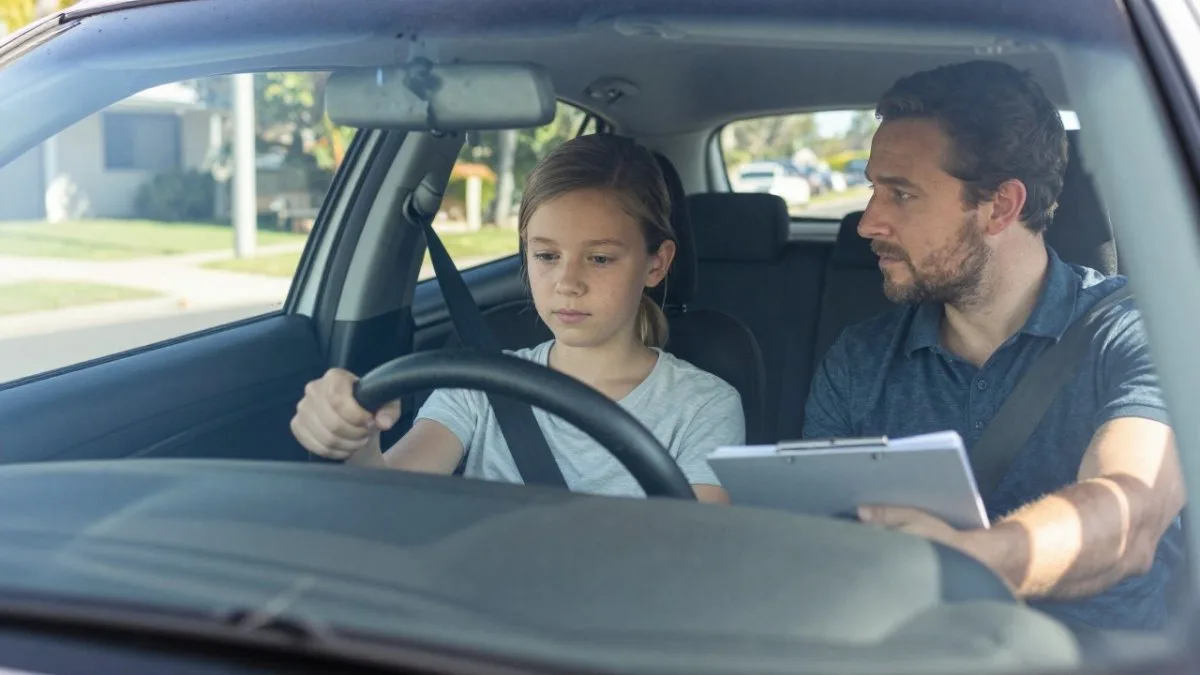
!A learner driver with calm focus at the wheel of a dual-pedal car during a lesson, instructor seated beside them with a clipboard, bright daytime suburban street visible through the windscreen
Starting, stopping and observation
Use a fixed pull-out sequence: mirror, blind-spot head check, indicate, check again, release the handbrake, pull away smoothly. Stopping should be progressive and controlled, bringing the vehicle to a complete stop at the correct point rather than lurching forward.
A head check, turning your head to look over your shoulder, is what covers the blind spot that mirrors miss. Make it a habit before every lane change, turn and pull-out, and make it visible enough that the examiner can see it. A useful test is whether a passenger could describe where you looked; if the movement is too small to notice, it is too small to count.
Watch out: signalling after the head check rather than before it. The sequence is mirror, signal, head check, move, and reversing the order signals late to everyone around you.
Intersections, roundabouts and lane changes
At intersections, slow early, observe in all directions and only proceed when it is safe. Break the decision into steps: approach at a speed that lets you stop, scan left-right-left, identify the give-way rule that applies, confirm the gap, then commit smoothly without hesitating mid-turn. When turning left or right, position the car correctly, indicate in good time and check for pedestrians and cyclists before completing the turn.
At roundabouts, give way to traffic already in the circle, indicate your intended exit, and keep a steady speed. The repeatable sequence is: approach, check mirrors, indicate left if exiting at the first exit or indicate right if going beyond halfway, give way to the right, enter when clear, then indicate left before your exit.
For lane changes, use the same four steps every time: signal, check the mirror, perform a head check, then move across smoothly. A common mistake is changing lanes without the head check, which is a frequent source of marks lost.
Parking and reversing
Reverse parking rewards a slow, staged approach rather than a single confident sweep. Pull alongside the space, check mirrors and blind spots, select reverse, reverse slowly while checking all around, straighten as the vehicle enters the space, then secure the car and check your final position. Reversing should be done at walking pace so you have time to correct.
Watch out: relying only on the reversing camera or mirrors. The examiner expects physical observation, so turn your head and check the blind spots as well as the screens.
Complete stops at stop signs and traffic lights
A complete stop means the vehicle is fully stationary at the marked line, with observation before you move. At a stop sign, stop, scan both directions, then proceed only when clear. At traffic lights, stop behind the line on red and treat a green arrow as permission only for that movement. Rolling stops are one of the most common critical errors, so practise stopping fully every time rather than easing through when the road looks empty.
The steps below summarise the core manoeuvres the examiner watches, with the observation habit for each.
| Manoeuvre | Core sequence | Common error to avoid |
|---|---|---|
| Pull-out and lane change | Mirror, signal, head check, move | Skipping the head check |
| Stop sign | Stop fully, scan both ways, proceed when clear | Rolling through the stop |
| Intersection | Slow early, scan left-right-left, commit | Hesitating mid-turn |
| Roundabout | Give way right, enter when clear, indicate exit | Late or missing indicators |
| Reverse parking | Slow staged approach, check all around | Relying only on camera or mirrors |
| Traffic light | Stop behind the line on red | Treating green arrow as general permission |
Common VicRoads Driving Test Mistakes and How to Avoid Them
Most failures come from a short list of recurring errors. Being aware of them lets you guard against them during practice.
- Skipping the head check before lane changes or pull-outs
- Rolling through stop signs instead of coming to a complete stop
- Poor speed choice, either too fast for the conditions or too slow for the road
- Late or missing indicators, particularly when turning and changing lanes
- Hesitating at intersections or roundabouts, which can confuse other road users
- Failing to scan ahead, so you react late to hazards
Work through this list in your practice drives and ask your instructor to call out whenever you slip into one of these habits. Repeated correction is what turns a bad habit into a reliable one.
How Many Lessons Before a Driving Test Is Enough
There is no fixed number of lessons that guarantees a pass, because readiness depends on the learner. Some people build confidence quickly, while others need more time to make observation and decision-making automatic. Many learners find that the amount of practice matters less than the quality and variety of it.
A useful approach is to judge readiness by performance rather than by a lesson count. Ask yourself whether you complete the pre-drive check without prompting, stop consistently at the right points, and manage intersections and roundabouts calmly in a range of traffic. If you are still making the same errors repeatedly, more targeted lessons will help more than simply adding hours.
Mock test practice on routes similar to the test can also reveal gaps before the real assessment. Treat each mock test as a diagnostic, not a verdict.
VicRoads Driving Test Checklist for Test Day
Use this checklist the morning of your test:
- Documents and identification ready, as listed on your booking
- Vehicle checked: lights, brakes, dashboard and horn
- Mirrors and seat adjusted before you start
- Head check habit ready for every lane change and pull-out
- Speed matched to conditions, with early observation at intersections
- Calm breathing and a clear plan for each manoeuvre
Booking Your Next Lesson With Drive2Shine
If you want structured practice before your test, Drive2Shine offers lessons across Melbourne’s northern suburbs, including Meadow Heights, with qualified instructors and dual-pedal vehicles for both automatic and manual driving. Lessons are designed to suit both nervous learners and those who need focused test preparation.
For pricing and availability, please contact us directly, as we do not publish fixed prices here. You can also book a driving test in Melbourne with us once you feel ready.
Frequently Asked Questions
What should I practise before a VicRoads driving test?
Focus on the skills the assessor marks most closely: vehicle safety checks before you drive, smooth starting and stopping, mirror and head checks before every change of direction or lane, safe speed for the conditions, and correct give-way behaviour at intersections and roundabouts. Practise these on the roads you will actually drive, and ask your instructor to run timed mock tests so you get used to driving while being observed. Repeat the same routine until it is automatic rather than something you remember to do under pressure.
What are the most common mistakes in the VicRoads driving test?
Frequent problems include skipping or rushing head checks, failing to observe blind spots before changing lanes, stopping too far from the stop line, misjudging gaps at give-way signs and roundabouts, and speeding up or slowing down inappropriately for the traffic. Many candidates also forget to indicate early enough. Your instructor can point out these habits during lessons so you can correct them well before test day.
How many driving lessons should I take before my test?
There is no fixed number of lessons that guarantees a pass, because learners progress at different rates. Most people benefit from regular professional lessons combined with supervised practice, and the best guide is readiness rather than hours alone. If you can complete a full mock test with few errors and handle a range of traffic conditions calmly, you are likely close to ready. Drive2Shine instructors can assess your progress and recommend how many lessons suit your situation.
How does the VicRoads drive test work?
The test begins with a pre-drive check of your vehicle’s controls and safety equipment, followed by an on-road assessment in which an assessor observes how you drive in normal traffic. You will be asked to perform basic manoeuvres and follow directions. The assessor marks errors according to official criteria, and critical errors can end the test. Check the current requirements with VicRoads before booking, as procedures can change.
What should I do on the day of my driving test?
Arrive early, bring all required documents and your vehicle paperwork, and make sure the car is roadworthy and fitted with the required items. Do a short warm-up drive if you can, then take a few slow breaths before you start. During the test, follow the assessor’s directions calmly, keep checking your mirrors and blind spots, and if you make a mistake, keep driving safely rather than dwelling on it.
